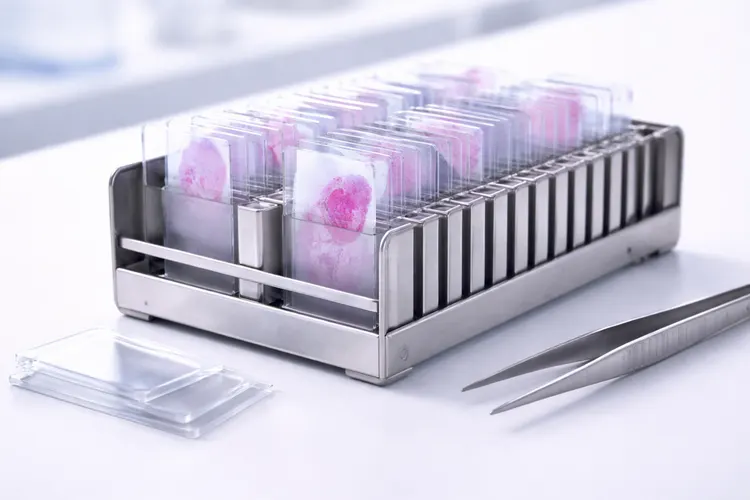
Pathology, the cornerstone of diagnosis, involves the detailed examination of tissues and fluids to identify disease. In the digital age, this discipline is undergoing a revolutionary shift with the adoption of Digital Pathology, which involves converting traditional glass slides into high-resolution Whole Slide Images (WSIs) that can be viewed and analyzed on a computer screen.
This transformation has created the perfect opportunity for Artificial Intelligence (AI) to step in. Given the increasing volume and complexity of tissue samples—coupled with a growing global shortage of pathologists—AI is no longer a luxury, but a necessity to maintain diagnostic speed and accuracy.
AI models bring quantitative, objective support to what has traditionally been a subjective discipline, enhancing clinical workflows and enriching diagnostic capabilities.
Atlas Meditech’s AtlasGPT is at the forefront of this movement. As an intelligent AI co-pilot, it integrates across all major medical specialties, including pathology, providing real-time, evidence-based support directly within the digital workflow.
Key Applications of AI in Digital Pathology
AI applications are transforming the pathologist’s work from labor-intensive manual review to high-efficiency, standardized analysis, particularly in the diagnosis and prognostication of cancer.
1. Automated Image Analysis and Quantification
The primary role of AI is to automate the most time-consuming aspects of WSI analysis, providing pathologists with precise, objective data:
Classification and Segmentation: AI algorithms automatically identify and delineate specific structures on the slide, such as tumor boundaries, cellular features, and specific cell types (e.g., lymphocytes). This is crucial for cancer staging and grading.
Standardizing Grading: AI excels at quantitative histomorphometry (QH) analysis, which captures metrics like nuclear orientation, texture, and shape across the entire tissue landscape Advances in Digital Pathology. By standardizing the assessment of criteria, AI reduces inter-observer variability—a long-standing challenge in grading cancers like breast and prostate cancer.
Reducing "No-Touch" Cases: Algorithms can rapidly screen slides to identify normal or low-risk samples, allowing pathologists to focus their expertise on the complex, diagnostically challenging cases.
2. Enhanced Diagnostic Support and Prognostication
AI moves beyond simple automation to provide deeper clinical insights:
Micro-Metastasis Detection: AI models are significantly more sensitive than the human eye at detecting small clusters of malignant cells, such as lymph node metastases, especially in common cancers like breast and colorectal cancer.
Predicting Molecular Subtypes: By analyzing H&E (Hematoxylin and Eosin) images, AI can infer molecular and genetic information—such as predicting gene mutations or microsatellite instability—a capability often unattainable by manual review. This links pathology directly to precision medicine.
The AtlasGPT Advantage in Pathology
AtlasGPT is specifically designed to be the pathologist’s ultimate decision-support tool, leveraging its multi-specialty knowledge base:
Feature | Description |
Full Workflow Integration | Designed for compliant, real-time integration with LIS, WSI scanners, and EHRs for seamless case management. |
Diagnostic Prioritization | Uses AI-driven analysis to flag critical features and prioritize high-risk or complex cases, optimizing the pathologist's workload. |
Prognostic Insight | Provides AI-driven prediction models for patient-specific outcomes based on image features, genetic data, and clinical history. |
Quantification & Standardization | Offers objective, quantitative measurements of tissue features, reducing subjectivity and standardizing reports across a practice. |
FAQs About Digital Pathology AI
What is Digital Pathology?
It is the use of whole slide imaging (WSI) technology to digitize glass slides, allowing them to be viewed, analyzed, and managed digitally on a computer screen.
How does AI enhance pathology diagnosis?
AI automates repetitive tasks (like cell counting), detects subtle patterns, standardizes cancer grading (morphometry), and helps prioritize critical cases for the pathologist.
Is AI replacing pathologists?
No. AI is an indispensable tool that augments the pathologist's ability to analyze massive datasets, improve efficiency, and maintain accuracy. The final diagnosis and clinical interpretation remain the responsibility of the human expert.
What is Whole Slide Imaging (WSI)?
WSI is a technique that uses specialized scanners to create a single, high-resolution digital image of an entire glass slide, enabling remote viewing and computational analysis by AI.
Elevate Your Diagnostic Power with AtlasGPT
The fusion of AI with Digital Pathology is not just a technological advancement; it's a leap forward for patient care. By automating analysis, standardizing diagnosis, and delivering powerful prognostic insights, AI empowers pathologists to work faster, smarter, and with greater confidence.
Experience AtlasGPT in Pathology today to discover how an intelligent co-pilot can transform your diagnostic lab.